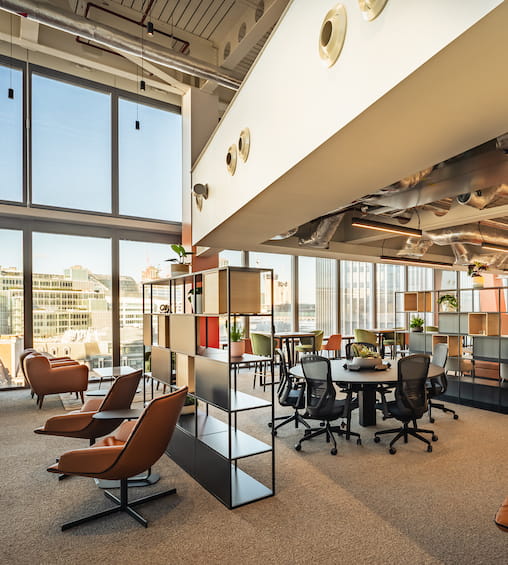
Compare serviced offices, managed offices, coworking and traditional leases in London by cost, flexibility, privacy and team size.
Serviced office, managed office, coworking or traditional lease? Compare the costs, contract lengths, what is included and which option makes sense for 10, 20 and 50-person London teams.
Choosing an office in London is no longer simply a choice between renting a desk and signing a lease.
A business can now choose between coworking, serviced offices, managed offices and traditional leased space, with very different levels of flexibility, privacy, responsibility and financial commitment.
The distinction matters because the cheapest-looking option is not always the cheapest overall.
A traditional lease may have an attractive headline rent, but the business may also need to pay for fit-out, furniture, business rates, service charges, utilities, internet, cleaning, maintenance and professional fees. A serviced office usually has a higher headline price but bundles most day-to-day occupancy costs into one monthly payment.

That uncertainty comes up repeatedly among founders. One r/startups discussion described exactly the dilemma: take a conventional office that may be too small within a year, or use a six-month private office within a coworking building and retain the ability to move as the company grows.
For most businesses, that question of certainty is the best place to begin.
Serviced vs managed vs coworking vs lease at a glance
| What is it? | Coworking | Serviced office | Managed office | Traditional lease |
|---|---|---|---|---|
| Shared workspace used by multiple businesses | Your own ready-to-use office inside an operated building | Private, usually self-contained office managed for you | Space rented directly from a landlord | |
| Typical commitment | Monthly or rolling | Often months to 1–2 years | Usually 1–5 years | Commonly 3–10+ years |
| Private office? | Usually no, unless upgraded | Yes | Yes | Yes |
| Furniture included? | Yes | Yes | Usually | Usually your responsibility |
| Utilities included? | Yes | Usually | Usually | No |
| Business rates included? | Usually | Usually | Usually | No |
| Cleaning included? | Usually | Usually | Usually | Usually your responsibility |
What is a coworking space?
Coworking gives individuals or teams access to a shared workspace without giving the business its own permanent office.
You will normally share kitchens, lounges, meeting rooms and working areas with people from other companies.
Depending on the membership, you might have an assigned desk or simply choose any available desk when you arrive.
Greater London’s median starting coworking membership was £195 per month in Q2 2026, according to CoworkingCafe. The same dataset puts the median London meeting-room rate at £54 an hour.
Advantages of coworking
Coworking offers the lowest barrier to entry. There is little setup, commitments can be short and a business does not need to pay for an office that sits empty on remote-working days.
It can work particularly well for:
- founders and solo workers
- teams attending two or three days per week
- businesses testing whether employees actually want an office
- temporary project teams
- companies entering London before committing to permanent premises.
Disadvantages of coworking
Privacy and consistency are the main trade-offs.
You may not have the same desk every day, meeting rooms are shared and phone calls can require booths or communal areas. Larger teams may also find that coordinating 20 or 30 people within shared coworking becomes more complicated than simply taking a private office.
A recent London founder discussion illustrates the problem well. The poster liked the human interaction offered by coworking but found some environments too chaotic, with insufficient privacy and the possibility of constantly changing desks.
Coworking therefore works best when flexibility matters more than ownership of the environment.
What is a serviced office?
A serviced office gives your company its own private office, but the building and its services are run by an operator.
You normally arrive to find furniture, internet and infrastructure already in place. Kitchens, lounges, reception and meeting rooms are often shared with other companies.
The monthly fee commonly covers rent, business rates, utilities, internet, cleaning and building maintenance, although meeting-room usage, printing, storage and specialist connectivity may cost extra.
London’s current flexible-office benchmark is around £625 per desk per month, with mainstream serviced and private offices broadly falling between approximately £450 and £800 per desk.
Advantages of serviced offices
The biggest advantage is simplicity.
You can take a private office without buying furniture, arranging broadband, hiring cleaners or taking responsibility for the building.
They also make uncertainty much easier to handle. If a 10-person business becomes a 15-person business, it may be possible to move to another office within the same building or operator rather than starting an entirely new property search.
Disadvantages of serviced offices
You normally pay a premium for that convenience.
You also have less control over design and branding than you would in a managed or leased office.
Meeting rooms can be another hidden cost. Two serviced offices quoting exactly £600 per person are not necessarily equivalent if one includes meeting-room credits and the other charges by the hour.
LondonOffices currently lists plug-and-play space as particularly suitable for teams of roughly 2 to 50 people.
What is a managed office?
Managed office space sits between a serviced office and a traditional lease.
Your business normally gets a self-contained office rather than simply a private room within a larger shared environment. You can usually have more input into the layout, furniture, meeting rooms, branding and overall look of the space.
The provider then handles much of the property management.
This is why managed space is often attractive to businesses that have outgrown shared serviced environments but do not want to take on the responsibility and commitment of a conventional lease.
Advantages of managed offices
You get considerably more control without needing to become your own facilities manager.
A 30-person business, for example, might want:
- its own kitchen
- internal meeting rooms
- dedicated breakout space
- company signage
- branded walls and finishes
- specific desk layouts
- private IT infrastructure
That is difficult to achieve in conventional coworking and may be restricted within a smaller serviced suite.
Managed space allows much more of that to be designed around the business.
Disadvantages of managed offices
The trade-off is commitment.
Managed offices generally require longer terms than coworking or serviced space. Tally currently describes typical managed terms as roughly one to five years, compared with one to 24 months for serviced space.
Pricing can also be difficult to compare because one provider may include fit-out, furniture and meeting rooms while another structures the deal differently.
Current London managed-office listings analysed by Tally range broadly from around £320 to £960 per desk per month, with substantial differences by location and specification.
Read our guide to managed and self-managed offices in London
What is a traditional office lease?
A traditional commercial lease is the most conventional model.
Your business rents space directly from a landlord, normally for several years, and takes greater responsibility for creating and operating the office.
LondonOffices’ commercial leasing guide describes typical lease lengths as approximately three to ten years.
Unlike a serviced-office quote, the rent itself is only one part of the cost.
Businesses may also be responsible for:
- business rates
- service charge
- furniture
- design and fit-out
- electricity and utilities
- internet
- cleaning
- repairs and maintenance
- insurance
- professional and legal fees
- dilapidations when leaving.
Fit-out alone can represent a substantial upfront investment.
Advantages of a lease
Control is the main attraction.
The space is yours for the duration of the lease, allowing the business to create an environment around its brand, employees and operational requirements.
For a large company planning to stay in the same place for many years, a lease can also become economically attractive because setup costs can be spread over a longer period.
Disadvantages of a lease
The downside is difficult to ignore if headcount is uncertain.
If you lease space for 50 people and end up employing 30, you still pay for the other 20 desks.
If you lease for 30 and grow to 50, expanding may require taking additional space elsewhere or relocating entirely.
That risk is one reason early-stage founders frequently question whether committing to an office is sensible. In r/startups, discussions range from founders questioning whether an office is necessary at all to businesses specifically looking at temporary coworking because their next stage of growth is unpredictable.
Read our commercial office leasing guide for London