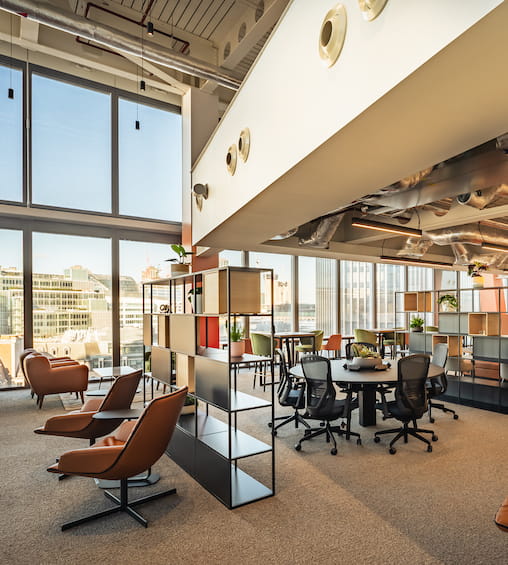
Not sure how much office space your team needs?
Match your headcount, hybrid working pattern and growth plans to the right type of London office, the likely monthly cost and the facilities that matter at each stage.
Most office searches start with a headcount. A better starting point is attendance: how many people will actually be in the office on the busiest normal day?
A company with 20 employees may only have 12 people in regularly because of hybrid working. Paying for 20 permanent desks in that situation may be unnecessary.
This guide walks through six team-size scenarios, from two people to 200, with the likely office model, indicative costs and what to look for at each stage.
A useful way to choose office space is to think one stage ahead without paying for two stages ahead. A five-person team does not need the same environment as a 20-person company, but it should still ask what happens when another three or four people join. The best flexible buildings make that progression easy: coworking or a small private room at the beginning, then larger private suites, managed space or a whole floor later. In London, that growth path is particularly important because moving between the City, Shoreditch, London Bridge, King’s Cross, Soho and Canary Wharf can change commute patterns as well as cost.
For teams of two to five, flexibility usually matters more than ownership of the environment. A small private room can be worthwhile if calls, equipment or confidential work make open coworking difficult. Teams of six to ten normally benefit from a dedicated office, because coordinating a group inside shared coworking becomes harder and meeting-room use starts to increase. At 10 to 20 people, the decision shifts again: meeting rooms, phone booths, breakout space, storage and the ability to keep teams together become much more important than simply finding enough desks.
Once a team reaches 20 to 50 people, compare the whole office rather than the per-desk rate. A managed office may look more expensive at first but can include private meeting rooms, a kitchen, branding and dedicated collaboration space that would otherwise be booked separately. For 50-plus people, conventional leasing also becomes worth comparing, especially when headcount is stable. But the longer commitment only works if the business can predict its requirements with confidence.
Hybrid working changes all of these thresholds. Start with the busiest normal day, not the total payroll headcount. If 30 employees translate into 18 people in the office on a Tuesday, paying for 30 permanent desks may be unnecessary. Equally, do not reduce the desk count so aggressively that the office fails whenever the whole team meets. Build the requirement around peak attendance, meeting behaviour and the amount of quiet space people need.
At a planning benchmark of around £625 per desk per month, even small differences in headcount can materially change the budget. That is why the right office model is not simply a size question. It is a balance between current attendance, expected growth, privacy, facilities and how much commitment the company is comfortable taking on.
A practical scenario helps. Imagine a six-person team that expects to reach 10 within a year. Taking a six-desk room with no expansion path saves money now but creates a likely move. Taking a 12-desk room immediately wastes space. The stronger answer is usually a building with an eight-person room and a larger suite available later. That is the kind of growth path to look for in London.
A useful shortlist should always include at least one realistic alternative rather than three versions of the same choice. Compare a premium option, a mid-market option and a value-led option where possible. That makes the trade-offs visible and gives the team a much better basis for deciding whether a higher price is genuinely justified.
Before a viewing, write down the five things that would make you reject the office immediately. During the tour, test those first. Then look at the softer factors such as design, atmosphere and communal space. This prevents a strong first impression from hiding a weak contract, poor meeting-room setup or difficult commute.
When two offices are close, model the next 12 months rather than just the first month. Add expected headcount, meeting-room usage and any recurring extras. A flexible office that costs slightly more today may be cheaper than moving again six months later because the first space cannot support growth.
Start your London office search

How to read the cost figures
For flexible private office space in London, around £625 per desk per month is a useful 2026 mid-market planning figure. Most mainstream serviced and private offices sit between roughly £450 and £800 per desk per month.
At the £625 benchmark, 5 people is around £3,125 per month, 10 people around £6,250, 20 people around £12,500 and 50 people around £31,250.
These are planning figures rather than quotes. Location, building specification and what is included can all move the real price.
2–5 people
Likely model
Coworking or a small serviced office.
What to prioritise
Flexibility, a short minimum term and access to meeting rooms when you need them rather than paying for a dedicated room.
Watch out for
Desk-only pricing that excludes meeting rooms, printing or storage.
6–10 people
Likely model
A dedicated private serviced office.
What to prioritise
Phone booths, a lockable space and a way to add desks. A team of eight that expects to reach twelve should avoid an office with no expansion option.
Watch out for
Choosing a space that is already full on move-in day.
10–20 people
Likely model
A private office with strong meeting-room and breakout facilities.
What to prioritise
Meeting-room availability, kitchen and social space, and a clear route to a larger suite in the same building.
Watch out for
Meeting-room charges that rise quickly once the whole team is using the building.

20–50 people
Likely model
Compare serviced offices with managed workspace.
What to prioritise
Privacy, branding, layout control and how quickly you need to move in. Managed space can feel more like your own office without the commitment of a traditional lease.
Watch out for
Comparing only the headline desk rate. Check inclusions, deposits and break options.
50–100 and 100–200 people
Likely model
Larger managed offices, whole floors and bespoke workspace, alongside conventional leasing.
What to prioritise
Delivery timeline, fit-out responsibility, expansion rights and who runs the building day to day.
Watch out for
Longer commitments can make sense for stable teams, but they also bring more property responsibility and less flexibility. For larger requirements, compare managed and leased options on total occupancy cost, fit-out responsibility and the ability to expand.
Plan for hybrid working
Hybrid patterns change the maths. If a team is in on Tuesday to Thursday, the busiest day matters more than the weekly average.
Ask three questions before you set a desk number:
- How many people are in on the busiest normal day?
- How often does the whole team need to be together?
- How many meeting rooms and phone booths will that pattern need?
Where London Offices helps
London Offices works with more than 600 offices across London and has helped more than 10,000 businesses find workspace. Its advisers take your team size, budget and preferred areas, then shortlist suitable options. The search service is free to businesses.
London Office Search & Broker Service
Start your London office search
Define the team. Set the budget. Choose two or three areas. Then compare a small number of offices against the same criteria.
Start your London office search
For further reading, explore Small Office Space in London for 2–10 People, the London Office Cost & Price Index 2026 and Serviced vs Managed vs Coworking vs Traditional Lease.